DevOps Engineering with AWS, Python & AI
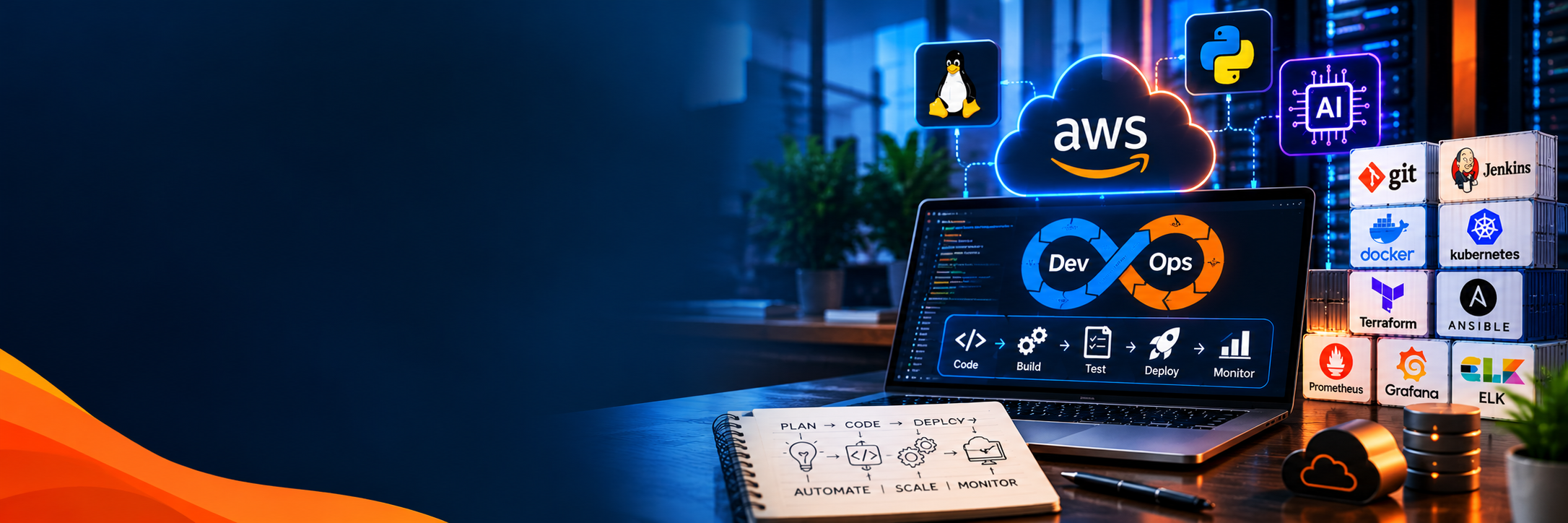
Build practical DevOps skills with ASAI's 4-month industry-focused training program covering AWS, Python, AI-assisted automation, Linux, Git, Jenkins, Docker, Kubernetes, Terraform, Ansible, and Monitoring. Learn CI/CD pipelines, cloud infrastructure, automation, and deployment workflows through hands-on projects and guidance from experienced IT professionals.
Course Overview
The DevOps Engineering with AWS, Python & AI Training Program at Atmasamman School of AI (ASAI) is a comprehensive 4-month industry-focused course designed to help learners develop practical skills in DevOps tools, cloud infrastructure, automation, and modern application deployment workflows. The course begins with Linux, networking, Bash Shell Scripting, Git, and Python fundamentals before progressing to CI/CD using Jenkins, Docker containerization, Kubernetes orchestration, Terraform, Ansible, and AWS cloud services. Students also explore monitoring and observability using Prometheus, Grafana, and ELK, along with practical applications of AI-assisted troubleshooting, log analysis, scripting, and DevOps workflows. The program emphasizes real-world scenarios, authorized infrastructure demonstrations, practical assignments, hands-on laboratories, and an integrated DevOps project. Learn from experienced industry professionals and understand how DevOps teams collaborate to build, automate, deploy, monitor, and manage modern technology infrastructure. Course Duration: 4 Months Course Level: Beginner to Intermediate / Job-Oriented Core Technologies: Linux, AWS, Python, Git, Jenkins, Docker, Kubernetes, Terraform, Ansible, Prometheus, Grafana and AI Tools Learn DevOps. Master Automation. Build Your Cloud Career with ASAI.
Why Learn This Course?
Modern software delivery increasingly relies on automation, cloud computing, containerization, continuous integration, continuous deployment, and infrastructure management. DevOps brings development and operations practices together to improve how teams build, test, deploy, monitor, and maintain applications. Learning DevOps helps you understand the complete software delivery lifecycle, from source code management to infrastructure provisioning, deployment, monitoring, and troubleshooting. AWS provides practical cloud infrastructure knowledge, while Python and Bash enable workflow automation and scripting. AI-assisted tools can support DevOps engineers with documentation, log analysis, troubleshooting, script development, and operational productivity when used with appropriate human verification and security controls. This course combines these technologies into one structured learning roadmap, giving students a foundation for DevOps, Cloud Computing, Infrastructure Automation, Application Support, and IT Operations careers.
Skills & Technologies Covered
Course Highlights
Curriculum
1. Module 1: DevOps Fundamentals & IT Infrastructure
- Introduction to DevOps and DevSecOps concepts
- Software Development Life Cycle (SDLC)
- Agile, DevOps, and collaboration practices
- Development, Testing, Staging, and Production environments
- Continuous Integration and Continuous Deployment
- Introduction to cloud infrastructure
- Understanding servers, applications, and infrastructure
- Overview of the complete DevOps toolchain
- Understanding real-world DevOps workflows
2. Module 2: Linux, Networking & Shell Scripting
- Linux operating system architecture and basics
- Essential Linux commands and file management
- Linux file permissions and user management
- Linux process and service management
- Linux networking fundamentals
- IP addressing, DNS, ports, and connectivity
- SSH and remote server administration
- Bash scripting fundamentals
- Commands for monitoring and troubleshooting
- Practical Linux administration exercises
3. Module 3: Python for DevOps Automation
- Introduction to Python and its role in DevOps
- Python installation and environment setup
- Variables, data types, and operators
- Conditional statements and loops
- Functions and modules
- File handling and exception handling
- Working with JSON and configuration files
- Python subprocess and operating system utilities
- Introduction to REST APIs
- Writing basic infrastructure automation scripts
- Python-based monitoring and reporting exercises
4. Module 4: Git, GitHub & Maven
- Introduction to version control
- Git installation and configuration
- Git repository initialization
- git add, commit, status, log, and diff
- Branching and merging
- GitHub remote repository management
- Pull requests and collaboration workflows
- Introduction to build automation
- Apache Maven fundamentals
- Maven project structure and lifecycle
- pom.xml and dependency management
- Practical application build exercises
5. Module 5: Jenkins & CI/CD Pipelines
- Introduction to Jenkins
- Jenkins architecture and components
- Jenkins installation and initial configuration
- Jenkins jobs and build triggers
- Integrating Jenkins with GitHub
- Introduction to Jenkins Pipeline
- Declarative pipelines and Jenkinsfile
- Continuous integration workflows
- Automated build and testing stages
- Credentials management fundamentals
- Pipeline notifications and logs
- CI/CD pipeline troubleshooting
- Practical Jenkins pipeline project
6. Module 6: Docker Containerization
- Introduction to containers and virtualization
- Docker architecture and components
- Docker installation and CLI
- Docker images and containers
- Dockerfile creation
- Container lifecycle management
- Docker volumes and networking
- Docker registries and image publishing
- Docker Compose fundamentals
- Multi-container application configuration
- Container troubleshooting and logging
- Practical application containerization
7. Module 7: Kubernetes Fundamentals
- Introduction to Kubernetes
- Kubernetes architecture
- Control plane and worker nodes
- Introduction to kubectl
- Pods and Deployments
- Kubernetes YAML manifests
- ReplicaSets and scaling
- Kubernetes namespaces
- Services and networking fundamentals
- ConfigMaps and Secrets
- Application deployment exercises
- Kubernetes troubleshooting basics
8. Module 8: Kubernetes Advanced Fundamentals & Helm
- Kubernetes Ingress concepts
- Rolling updates and rollbacks
- Resource requests and limits
- Liveness and readiness probes
- Persistent Volumes and Persistent Volume Claims
- Introduction to Horizontal Pod Autoscaling
- Kubernetes configuration management
- Helm architecture
- Helm charts and releases
- Deploying applications using Helm
- Kubernetes application troubleshooting
- Practical Kubernetes deployment project
9. Module 9: Terraform — Infrastructure as Code
- Introduction to Infrastructure as Code
- Terraform architecture and workflow
- Terraform installation
- Providers and resources
- Terraform configuration files
- terraform init, plan, apply, and destroy
- Input variables and output values
- Terraform state management
- Terraform modules
- Resource dependencies
- Infrastructure provisioning on AWS
- Terraform troubleshooting
- Practical infrastructure automation project
10. Module 10: Ansible — Configuration Management
- Introduction to configuration management
- Ansible architecture and components
- Ansible installation and configuration
- Inventory management
- Ad-hoc commands
- Writing Ansible playbooks
- Variables and facts
- Tasks, handlers, and templates
- Conditional execution
- Loops and reusable roles
- Automating software installation
- Linux server configuration and patching
- Ansible practical automation project
11. Module 11: AWS Cloud Computing Fundamentals
- Introduction to AWS Cloud
- AWS global infrastructure
- AWS account structure and cost awareness
- AWS IAM users, roles, and policies
- Amazon EC2 instances
- EC2 networking and security groups
- Amazon S3 storage
- Introduction to AWS VPC
- Public and private subnets
- Route tables and internet gateways
- Introduction to Elastic Load Balancing
- AWS cloud security fundamentals
- Practical AWS configuration labs
12. Module 12: AWS DevOps Infrastructure & Deployment
- Amazon RDS fundamentals
- AWS Auto Scaling concepts
- AWS CloudWatch monitoring
- Amazon ECR fundamentals
- Amazon EKS introduction
- Kubernetes applications on AWS
- Application Load Balancers
- Integrating AWS with Terraform
- Deploying applications to AWS lab infrastructure
- IAM roles and least-privilege permissions
- Deployment troubleshooting
- AWS cost monitoring and resource cleanup
- Practical cloud deployment exercises
13. Module 13: Monitoring, Logging & Observability
- Introduction to monitoring and observability
- Infrastructure and application metrics
- Prometheus architecture
- Metrics collection and exporters
- Prometheus queries fundamentals
- Grafana installation and dashboards
- Dashboard creation and visualization
- Alerting fundamentals
- Introduction to centralized logging
- ELK Stack architecture
- Elasticsearch, Logstash, and Kibana concepts
- Log aggregation and searching
- Basic incident detection and troubleshooting
- Practical monitoring dashboard project
14. Module 14: AI-Assisted DevOps & Automation
- Role of AI in modern DevOps workflows
- Introduction to AI-assisted command and script development
- AI-assisted Bash and Python automation
- Analyzing sanitized infrastructure logs using AI tools
- AI-assisted CI/CD troubleshooting
- Generating documentation and runbooks
- Understanding AI-assisted incident analysis
- Reviewing AI-generated Terraform and YAML configurations
- Prompt design for technical troubleshooting
- Security and privacy when using AI tools
- Human verification of AI-generated commands
- Practical AI-assisted troubleshooting exercises
15. Module 15: End-to-End DevOps Capstone Project
- Understanding project architecture and requirements
- Creating and managing a GitHub repository
- Building the application with Maven
- Configuring Jenkins CI/CD pipelines
- Creating a Docker image
- Managing container images
- Deploying an application using Kubernetes
- Provisioning required AWS lab resources with Terraform
- Applying configuration management where appropriate
- Setting up monitoring using Prometheus and Grafana
- Testing deployments and troubleshooting failures
- Documenting the complete DevOps workflow
16. Module 16: Project Finalization & Career Preparation
- Completing the end-to-end DevOps project
- CI/CD pipeline testing and optimization
- Linux and networking troubleshooting review
- Docker and Kubernetes troubleshooting
- AWS infrastructure troubleshooting
- Terraform and Ansible scenario-based exercises
- Monitoring and log analysis exercises
- Python and Bash automation review
- DevOps architecture explanation practice
- Real-world incident and deployment scenarios
- DevOps technical interview questions
- Resume and project presentation guidance
- Final project demonstration
- Course knowledge assessment
Practical Projects
Learning Outcomes
Career Opportunities
Meet Your Trainer
Pankaj Sharma & Gaurav
Senior DevOps & Cloud Infrastructure Mentor
Learn DevOps, AWS Cloud, Python, and Infrastructure Automation through practical guidance from experienced IT industry professionals at Atmasamman School of AI (ASAI). The mentoring approach draws on enterprise IT infrastructure and operations experience, focusing on Linux, cloud environments, CI/CD pipelines, containerization, Kubernetes, infrastructure automation, monitoring, and real-world troubleshooting. Through supervised demonstrations, hands-on laboratories, technical assignments, and project-based learning, students gain exposure to professional DevOps workflows and strengthen their technical problem-solving skills.
Why Choose ASAI
Frequently Asked Questions
What is the duration of the DevOps Training Program?
The program duration is 4 months, covering DevOps fundamentals, AWS, Python, AI-assisted automation, CI/CD, containers, Kubernetes, infrastructure automation, and practical projects.
Can beginners join this DevOps course?
Yes. The course starts with foundational Linux, networking, scripting, and version control concepts before progressing to DevOps tools.
Does this course include AWS Cloud Computing?
Yes. The curriculum includes AWS fundamentals such as IAM, EC2, S3, VPC, RDS, CloudWatch, Load Balancers, and Amazon EKS.
Will I learn Python in this course?
Yes. The course includes Python fundamentals and practical scripting for DevOps automation, system monitoring, and operational tasks.
Does this course cover Artificial Intelligence?
Yes. Students will explore AI-assisted DevOps workflows, scripting, documentation, troubleshooting, and log analysis. It is not a separate advanced AI or machine learning certification.
Which DevOps tools will I learn?
The curriculum includes Git, GitHub, Maven, Jenkins, Docker, Kubernetes, Helm, Terraform, Ansible, AWS, Prometheus, Grafana, and ELK fundamentals.
Will I work on real-world DevOps projects?
Yes. The proposed training includes practical labs, CI/CD exercises, container deployment, AWS infrastructure automation, monitoring, and an integrated DevOps capstone project.
Does ASAI provide live industry infrastructure exposure?
The program is designed to include guided demonstrations of authorized industry workflows and hands-on lab environments. Access to actual production systems is not promised.
Who will train the students?
The program is guided by experienced IT industry professionals. The assigned trainers and their qualifications will be provided by ASAI.
Do I need programming knowledge before joining?
Prior programming knowledge is helpful but not mandatory. The course introduces the Linux, scripting, and Python fundamentals required for the training.
Is this course suitable for BCA, BSc, BA, BCom, and BTech students?
Yes. Students from different educational backgrounds can begin learning DevOps, provided they are willing to practice technical concepts regularly.
Can working professionals join this course?
Yes. The course is designed for freshers and working professionals interested in developing DevOps, Cloud, and Infrastructure Automation skills.
Will I learn Docker and Kubernetes?
Yes. The curriculum covers Docker containerization and Kubernetes concepts including Pods, Deployments, Services, Ingress, scaling, and Helm.
Does the program include Terraform and Ansible?
Yes. The course introduces Terraform for Infrastructure as Code and Ansible for configuration management and automation.
Will I create a complete CI/CD pipeline?
The proposed capstone project integrates GitHub, Jenkins, Docker, Kubernetes, AWS infrastructure, and monitoring into a practical delivery workflow.
Does ASAI provide interview preparation?
The proposed program includes technical interview questions, practical assessments, troubleshooting scenarios, project presentations, and career guidance.
Will I receive a certificate after completing the course?
Course completion certification is subject to ASAI's published attendance, assessment, and completion requirements. External vendor certifications, if any, must be specified separately.
What is the course fee?
Please contact ASAI for the current program fee, payment options, and any valid promotional offers.
Does completing this course guarantee a DevOps job?
No. The program focuses on practical technical skills and career preparation. Employment depends on individual skills, experience, qualifications, and hiring requirements.
How can I enroll in the course?
Click Enroll Now on the ASAI course page to proceed to the configured enrollment platform, or use Book Free Demo to request more information.
Book a Free Demo / Get Counselling
Have questions about DevOps Engineering with AWS, Python & AI? Share your details and our counsellor will reach out.
Ready to start DevOps Engineering with AWS, Python & AI?
Secure your seat and begin your journey with ASAI.