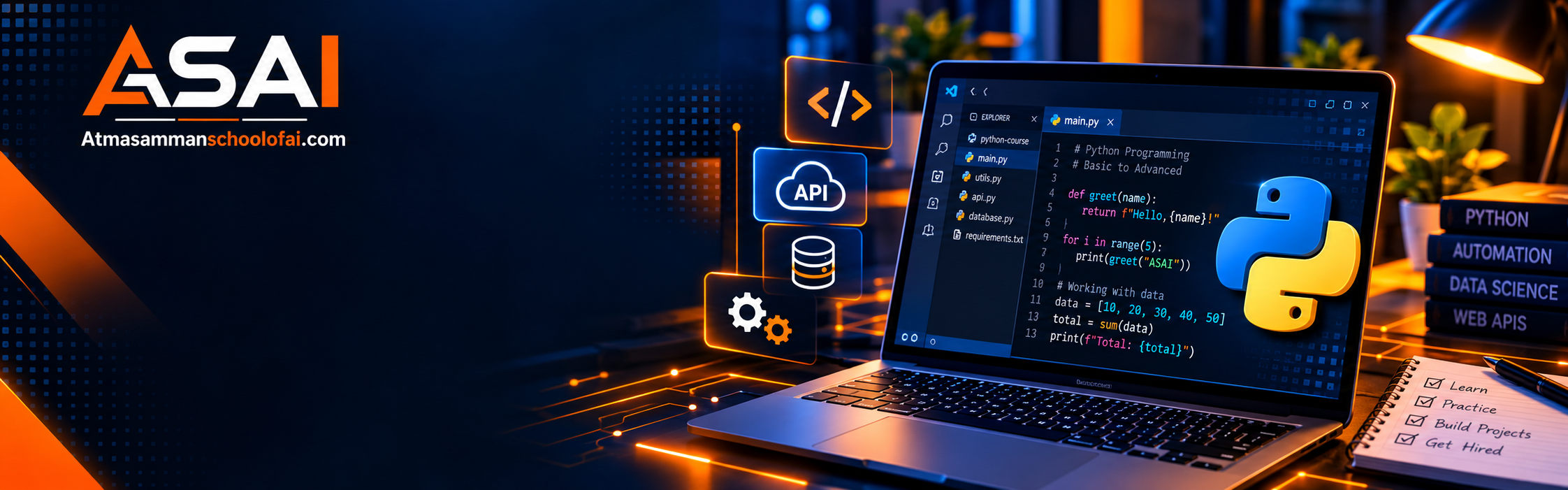
Python Programming – Basic to Advanced Training
Master Python Programming from basic to advanced with ASAI's 3-month practical training program. Learn Python syntax, data structures, functions, Object-Oriented Programming (OOP), file handling, exception handling, APIs, database connectivity, and automation through hands-on exercises and real-world projects. Build strong programming skills for software development, automation, data analysis, and IT careers.
Course Overview
The Python Programming – Basic to Advanced Training Program at Atmasamman School of AI (ASAI) is a comprehensive 3-month course designed to help students develop strong programming fundamentals and practical Python development skills. The course begins with Python installation, basic syntax, variables, data types, operators, conditional statements, and loops before progressing to functions, data structures, Object-Oriented Programming (OOP), file handling, exception handling, and advanced Python concepts. Students will also learn how to work with Python modules, packages, JSON data, APIs, database connections, and automation scripts. The training emphasizes hands-on coding practice, real-world assignments, debugging, problem-solving, and practical projects. This program helps learners build a foundation for Software Development, Python Automation, Data Analysis, Application Support, Software Testing, and further study in AI and Machine Learning. Course Duration: 3 Months Course Level: Beginner to Advanced Core Technologies: Python 3, VS Code, Jupyter Notebook, SQLite, Pandas, Git, and REST APIs Learn Python. Master Programming. Build Your IT Career with ASAI.
Why Learn This Course?
Python is widely used across software development, automation, data analysis, artificial intelligence, machine learning, cloud computing, and software testing. Its readable syntax makes it suitable for beginners, while its extensive libraries and frameworks support many advanced technical applications. Learning Python helps students develop logical thinking, programming fundamentals, problem-solving skills, and the ability to automate everyday tasks. Python can be used to develop applications, process Excel and CSV data, work with databases, connect to APIs, analyze information, and automate repetitive operations. It also provides a strong foundation for learning advanced technologies such as Data Science, AI, Machine Learning, Web Development, and DevOps Automation. ASAI's training program focuses on practical programming exercises, real-world projects, debugging skills, and technical problem-solving rather than theory alone. Whether you are starting your IT journey or expanding your existing technical abilities, Python is a valuable programming skill to learn.
Skills & Technologies Covered
Course Highlights
Curriculum
1. Module 1: Introduction to Python Programming
- Introduction to programming and Python
- Python features and applications
- Python in software development, AI, and automation
- Installing Python 3
- VS Code and Jupyter Notebook fundamentals
- Writing and executing Python programs
- Python syntax and indentation
- print() and input() functions
- Comments and basic coding practices
- Understanding programming errors
- First Python programming exercises
2. Module 2: Python Variables, Data Types & Operators
- Python variables and naming conventions
- Integer, float, string, and Boolean data types
- Type conversion and type checking
- Arithmetic operators
- Comparison operators
- Logical operators
- Assignment operators
- Membership and identity operators
- String indexing and slicing
- String methods and formatting
- Basic programming exercises
3. Module 3: Conditional Statements & Loops
- if statements
- if-else and elif
- Nested conditional statements
- Conditional expressions
- for loops
- while loops
- range() function
- break, continue, and pass
- Nested loops
- Loop else clauses
- Pattern and number-based programming exercises
- Logical problem-solving practice
4. Module 4: Python Data Structures
- Introduction to Python collections
- Lists and list operations
- List methods and slicing
- Tuples and tuple operations
- Sets and set operations
- Dictionaries and key-value pairs
- Dictionary methods
- Nested lists and dictionaries
- Iterating through collections
- List comprehensions
- Dictionary and set comprehensions
- Practical data structure problems
5. Module 5: Python Functions & Modular Programming
- Introduction to functions
- Defining and calling functions
- Parameters and arguments
- Return statements
- Default and keyword arguments
- Variable-length arguments
- Local and global scope
- Lambda functions
- map() and filter() fundamentals
- Introduction to recursion
- Creating and importing Python modules
- Code reuse and modular programming
- Practical function-based exercises
6. Module 6: Object-Oriented Programming (OOP)
- Introduction to Object-Oriented Programming
- Classes and objects
- Attributes and methods
- Constructors using __init__
- Instance and class variables
- Instance, class, and static methods
- Encapsulation fundamentals
- Inheritance and method overriding
- Polymorphism
- Abstraction fundamentals
- Special methods and object representation
- Practical OOP-based application development
7. Module 7: Exception Handling & File Management
- Introduction to exceptions
- Common Python exceptions
- try and except
- else and finally
- Raising exceptions
- Creating custom exceptions
- File opening and closing
- Reading text files
- Writing and appending files
- Using the with statement
- Working with file paths
- CSV file reading and writing
- JSON file processing
- File handling exercises
8. Module 8: Intermediate & Advanced Python Concepts
- Python modules and packages
- Installing packages using pip
- Virtual environments using venv
- Introduction to iterators
- Generators and yield
- Decorator fundamentals
- Regular expressions using re
- Working with datetime
- Working with os and pathlib
- Introduction to the collections module
- Debugging Python code
- Code readability and PEP 8 fundamentals
- Practical advanced programming exercises
9. Module 9: Python Database Programming
- Introduction to relational databases
- Python database connectivity fundamentals
- Introduction to SQLite
- Creating database tables with Python
- Establishing database connections
- Executing SQL queries
- INSERT, SELECT, UPDATE, and DELETE operations
- Parameterized SQL queries
- Handling database exceptions
- Transactions and connection management
- Processing query results
- Building a database-driven Python application
10. Module 10: REST APIs & Python Automation
- Introduction to APIs and REST concepts
- HTTP methods and status codes
- Installing and using the Requests library
- Working with JSON API responses
- Sending GET and POST requests
- Query parameters and request headers
- API authentication concepts
- Request timeouts and exception handling
- Working with environment variables for configuration
- Introduction to Python task automation
- File and directory automation
- Basic scheduled script execution concepts
- API integration and automation exercises
11. Module 11: Excel Automation, Pandas & Testing Fundamentals
- Introduction to Python for data processing
- Reading and writing Excel files using OpenPyXL
- Working with rows, columns, and worksheets
- Data validation and transformation
- Automated Excel report generation
- Introduction to Pandas
- Series and DataFrames
- Reading CSV and Excel data
- Data filtering and grouping fundamentals
- Handling missing values
- Practical data reporting exercises
- Introduction to unit testing with unittest
- Git and GitHub fundamentals for Python projects
12. Module 12: Real-World Projects & Interview Preparation
- Revising core Python concepts
- Practical programming problem-solving
- OOP application exercises
- File processing and automation projects
- Python database application development
- API integration exercises
- Excel and CSV automation project
- Working with sample business data
- Exception handling and debugging challenges
- Basic code testing and documentation
- Python technical interview questions
- Resume and project explanation guidance
- Final project development
- Practical project demonstration
- Final knowledge assessment
Practical Projects
Learning Outcomes
Career Opportunities
Meet Your Trainer

Pankaj Sharma
Python Programming & Automation Trainer
Learn Python Programming with practical guidance from an ASAI technical trainer. The training focuses on developing strong programming fundamentals, Object-Oriented Programming, logical problem-solving, file handling, database connectivity, APIs, and automation. Through hands-on coding exercises, practical assignments, and project-based learning, students gain experience developing Python programs and solving real-world technical problems. The learning approach emphasizes programming confidence, debugging skills, clean coding practices, and practical application development.
Why Choose ASAI
Frequently Asked Questions
What is the duration of the Python Programming Course?
The course duration is 3 months, covering Python fundamentals, advanced concepts, practical programming, automation, and real-world projects.
Can beginners join this Python course?
Yes. The course starts with basic programming concepts and gradually progresses to advanced Python topics.
Do I need programming knowledge before joining?
No prior programming experience is required. Basic computer knowledge is sufficient to begin learning Python.
What will I learn in this course?
You will learn Python syntax, variables, data structures, functions, OOP, file handling, exception handling, APIs, database connectivity, automation, and practical projects.
Is Python difficult for beginners?
Python has a relatively readable syntax and is widely used for teaching programming. Regular practice is important for developing strong coding skills.
Does this course include advanced Python concepts?
Yes. The proposed syllabus covers OOP, generators, decorators, modules, packages, error handling, and practical application development.
Will I learn Object-Oriented Programming?
Yes. Students will learn classes, objects, inheritance, encapsulation, polymorphism, and abstraction fundamentals.
Does the course include database connectivity?
Yes. The course introduces SQLite connectivity and database operations using Python.
Will I learn Python automation?
Yes. Students will practice file automation, Excel data processing, API-based scripts, and other practical automation tasks.
Does this course cover Artificial Intelligence and Machine Learning?
This course provides a Python programming foundation useful for AI and Machine Learning. Advanced AI and ML model development are not part of the core curriculum.
Will I learn Python for Excel automation?
Yes. The proposed curriculum includes reading, modifying, and processing Excel files using Python and OpenPyXL.
Does the course include API integration?
Yes. Students will learn REST API fundamentals, HTTP requests, JSON responses, and practical integration using Python.
Will I work on practical projects?
Yes. The proposed curriculum includes student management, expense tracking, employee management, file automation, database applications, and data processing projects.
Is this course suitable for BCA, BSc, BTech, BA, and BCom students?
Yes. Students from technical and non-technical backgrounds can learn Python through structured practice.
Can working professionals join this course?
Yes. Working professionals can use Python to strengthen programming, automation, data processing, and problem-solving skills.
What career opportunities are available after learning Python?
Python skills are relevant to Junior Python Development, Software Development, Automation, QA, Application Support, and Data Analysis roles. Additional skills may be required.
Does ASAI provide technical interview preparation?
The proposed training includes coding exercises, debugging tasks, technical interview questions, and project explanation practice.
What is the course fee?
Please contact ASAI for current course fees and enrollment details.
Will I receive a certificate after completing the course?
Please contact ASAI for applicable course completion and certificate eligibility requirements.
Does this course guarantee job placement?
No. The course focuses on programming skills and technical career preparation. Employment depends on individual abilities, qualifications, and hiring requirements.
Book a Free Demo / Get Counselling
Have questions about Python Programming – Basic to Advanced Training? Share your details and our counsellor will reach out.
Ready to start Python Programming – Basic to Advanced Training?
Secure your seat and begin your journey with ASAI.